H.L. Scientific Industries :Introduction
-
H.L. Scientific Industries has been manufacturing and supplying laboratory equipment — from basic glassware to advanced scientific instruments — since 1963.
-
Our products serve a wide range of customers: educational institutions (schools, colleges, universities), research labs, industrial labs, medical/pharmacy colleges, and more.
-
We supply both glassware (borosilicate etc.) and plasticware, and also offer specialized instruments, showing their catalog is broad from everyday lab basics to advanced or specialized lab equipment.
100 Science Laboratory Apparatus and Their Uses
Below is a list of 100 frequently used lab apparatus / instruments, grouped by major categories (glassware, heating/processing, measuring instruments, microscopy & imaging, support/handling tools etc.), with a brief description of their main uses. Many of these are items supplied by H.L. Scientific Industries.
Glassware & Volume Measurement (General Containers)
-
Beaker – Simple cylindrical container with flat bottom and a spout. Used for mixing, heating, and holding liquids; for rough volume measurements.
-
Erlenmeyer Flask (Conical Flask) – Cone-shaped with narrow neck; ideal for mixing by swirling without spillage, titrations, storing solutions.
-
Volumetric Flask – Calibrated flask for one precise volume; used to prepare standard solutions and accurate dilutions.
-
Graduated Cylinder (Measuring Cylinder) – Tall, narrow cylinder with volume markings; for more accurate measurement of liquid volumes than beakers.
-
Test Tube – Small glass tube (open top, closed bottom). Used for small-scale reactions, heating small liquid samples, storing samples.
-
Test Tube Rack – A stand with holes to hold test tubes upright. Organizes and stores test tubes during experiments.
-
Test Tube Holder – A clamp-like tool to hold hot test tubes safely when heating or handling.
-
Pipette (Volumetric / Graduated) – A slender calibrated tube for transferring or measuring small, precise volumes of liquid.
-
Micropipette – Used to transfer microliter-scale volumes — essential in microbiology, molecular biology, or analytical labs. (H.L. Scientific includes such plasticware / glassware in its catalog.)
-
Pipette Bulb / Pipette-Filler – A bulb (or filler) used to safely draw liquid into pipettes, avoiding direct mouth pipetting.
-
Burette – A long graduated glass tube with a stopcock at the bottom, used in titrations to deliver very precise volumes of liquid reagent.
-
Glass Funnel (Filter Funnel) – A basic conical funnel used to pour liquids into containers with narrow openings, or to hold filter paper during filtration.
-
Separatory Funnel – A pear-shaped glass funnel with a stopcock, used in liquid-liquid extraction to separate immiscible liquids (e.g. organic vs aqueous layers).
-
Dropping Funnel – Similar to separatory funnel, often used to add reagents slowly into a reaction mixture.
-
Petri Dish – Shallow circular dish with lid; commonly used to culture microorganisms (bacteria, fungi), seeds, or cell cultures in biology labs.
-
Reagent / Storage Bottle – Glass or plastic bottle used for storing chemical reagents, prepared solutions, or samples safely.
-
Florence Flask (Round-Bottom Flask) – Flask with round body and narrow neck; ideal for uniform heating and boiling of liquids, reflux, distillations.
-
Flat-Bottom Flask – Similar to round-bottom but with flat base; easier to place on surface — used for heating or stirring when round-bottom not required.
-
Evaporating Dish – A shallow, heat-resistant dish used to evaporate solvents and concentrate solutions, or to dry precipitates.
-
Crucible (and Lid) – Very heat-resistant dish (ceramic, porcelain, or metal) used to heat substances to very high temperatures — for calcination, fusion, or decomposition of solids.
🔥 Heating, Cooling, Sterilization & Reaction Equipment
-
Bunsen Burner – A gas-flame burner providing open flame for heating chemicals, boiling, sterilization, and combustion experiments.
-
Hot Plate – A flat electric heating surface used to heat containers (beakers, flasks) without open flame — safer for flammable chemicals or where flame is undesirable.
-
Magnetic Stirrer (often with Hot Plate) – Combines stirring (via a magnetic stir bar) with heating — useful for mixing and heating solutions uniformly. Many labs use these for reactions requiring constant stirring and heating.
-
Water Bath – A container of water heated to a controlled temperature; used when gentle, uniform heating is required (e.g. incubations, thawing, enzyme reactions).
-
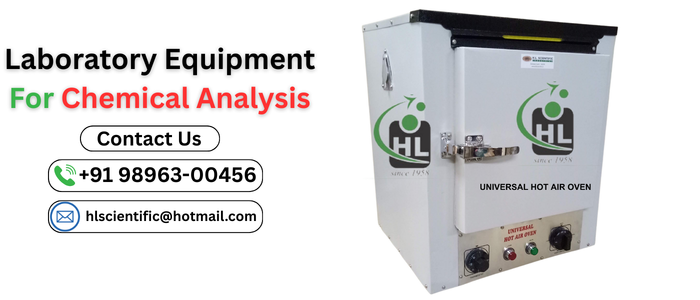
Drying / Hot Air Oven – Used for drying glassware, sterilizing equipment (when wet sterilization is not possible), or removing moisture / volatile solvents under heat.
-
Autoclave (Steam Sterilizer) – Sterilizes lab glassware, media, solutions, and instruments using steam under pressure — essential in microbiology, medical labs. (Though not explicitly enumerated up to 100 in H.L.’s list, it’s commonly part of lab instrumentation sets.)
-
Vacuum Oven / Vacuum Drying Equipment – Used to remove moisture or volatile solvents under reduced pressure; useful for drying heat-sensitive materials or samples.
-
Heating Mantle – A device to uniformly heat round-bottom flasks (especially where direct flame is dangerous), used in organic synthesis, distillation, reflux. (Included in general lab equipment categories in broader lab equipment lists.)
-
Evaporation Setup (Evaporating Dish + Heat Source + Funnel / Condenser) – For concentrating solutions, evaporating solvents, or separating solutes. Combined use of several apparatus. (General practice in labs.)
-
Distillation Apparatus – Used for separation of mixtures by boiling point differences; includes flasks (round-bottom), condensers, receivers, heating mantle or bath. (Listed among general lab sets in many equipment catalogues.)
📏 Measuring Instruments & Analytical Tools
-
Laboratory / Analytical Balance – For precise measurement of mass (chemicals, solids, samples) often to milligram accuracy — essential for quantitative experiments. (Though not always part of simplest glassware sets, balances are core measuring equipment commonly used in labs.)
-
Top-load / General Balance – Less precise than analytical balance but used for general weighing tasks (bulk reagents, larger samples).
-
Laboratory Thermometer – Measures temperature of liquids, solutions, or environments — basic but vital for reactions, incubations, calibrations.
-
pH Meter – Measures acidity or alkalinity of solutions; crucial in chemistry, biology, environmental, water-quality labs. (Mentioned in more extensive lab equipment lists.)
-
Conductivity Meter – Measures the electrical conductivity of a solution — useful in water analysis, purity checks, ionic strength determinations. (Part of more advanced lab instrument sets.)
-
Turbidity Meter – For measuring cloudiness or turbidity of liquid samples (e.g. water quality testing, environmental monitoring). (Included in H.L.’s broader equipment categories like “turbidity meter”.)
-
Dissolved Oxygen Meter – Used in environmental, water-quality or biological labs to measure oxygen concentration in water samples.
-
Karl Fischer Titrator / Moisture Analyzer – For measuring water content in samples — important in analytical chemistry, pharma, material testing. (Mentioned in H.L.’s measuring instruments category.)
-
Colony Counter – Used in microbiology labs to count bacterial or fungal colonies grown on culture plates (e.g. from Petri dishes).
-
Spectrophotometer / UV-Vis / Analytical Instruments – For measuring absorbance or transmission of light by samples; used in chemistry, biochemistry, molecular biology for concentration measurement, reaction monitoring, etc. (Part of “analytical & research instruments” in broad lab equipment lists.)
🔬 Microscopy & Imaging, Biological & Biological-Research Tools
-
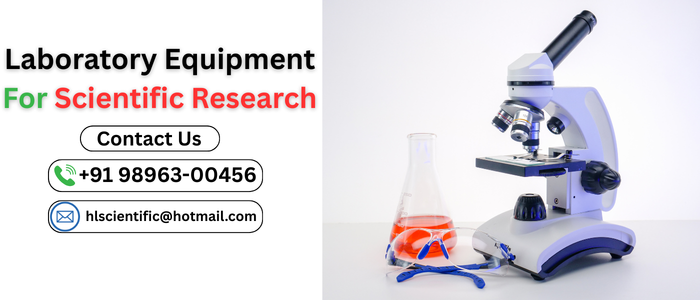
Light Microscope (Compound Microscope) – Uses visible light and lenses to observe cells, tissues, microorganisms — essential for biology, microbiology labs.
-
Compound Microscope (with multiple objective lenses) – Offers higher magnification and detail for thin samples — used in histology, microbiology, cytology.
-
Fluorescence Microscope – Uses fluorescent dyes and specific illumination to observe labeled molecules or structures in cells/tissues — essential in molecular biology, cell biology. (Though advanced, such instruments are often part of research-lab catalogs.)
-
Electron Microscope – Uses electrons instead of light for super-high resolution imaging — useful for ultrastructure studies in biology, material science, nanotechnology. (Listed among specialized instruments in broad lab-equipment references.)
-
Trinocular Microscope – A microscope with an extra eyepiece or camera port — useful for projecting or photographing samples or research documentation.
-
Microscope Slides – Flat glass pieces on which samples are placed for examination under a microscope.
-
Cover Slips – Thin small glass pieces placed over a sample on a slide to flatten and protect it during microscopy.
-
Culture Plates / Petri Dishes – As mentioned above: for growing bacteria, fungi, or cell cultures in microbiology / biology labs.
-
Incubator – Maintains a controlled temperature (and sometimes humidity, CO₂) environment — used for microbial culture growth, cell culture, incubation of biochemical reactions. (While not always in the “100 basic items,” it is often included in comprehensive lab equipment lists.)
-
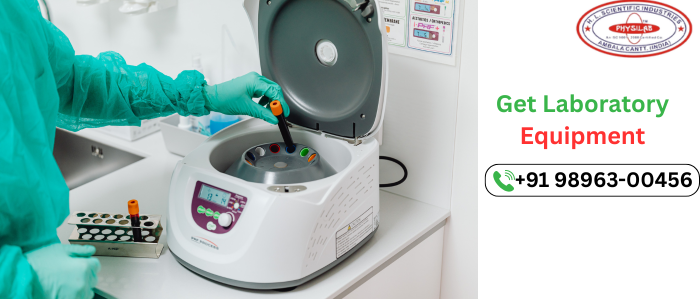
Centrifuge – Separates components of mixtures (cells, organelles, precipitates) by spinning at high speed — essential in biology, biochemistry, clinical labs. (Part of “analytical/research instruments” in general lab inventory lists.)
🛠️ Lab Support, Handling & Miscellaneous Tools
-
Stirring Rod (Glass Rod) – For mixing solutions manually — basic but essential for dissolving solids, making uniform solutions.
-
Magnetic Stir Bar – Used with magnetic stirrer to mix solutions without manual stirring — ideal for continuous stirring, especially for long-duration reactions.
-
Clamp & Stand (Retort Stand + Clamps) – Metal stand and clamps to hold flasks, burettes, condensers, funnels etc during experiments (heating, titrations, distillations).
-
Ring Clamp / Utility Clamp – Supports funnels, glassware during heating or filtration setup.
-
Wire Gauze – Placed on a ring clamp/stand under a flask/beaker during heating to distribute heat evenly and prevent glass breakage.
-
Beaker Tongs / Crucible Tongs – For holding or lifting hot containers (beakers, crucibles) safely.
-
Spatula / Scoopula / Solid-Handling Tools – For handling solid chemicals, scooping out powders, transferring solids — essential to avoid contamination and safe handling. (Common in general equipment lists.)
-
Mortar & Pestle – A bowl (mortar) and grinding tool (pestle) used to grind solid chemicals into fine powder — useful in preparing reagents, increasing surface area for reactions.
-
Desiccator – A sealed container used to store moisture-sensitive samples, crystals, or chemicals in a dry environment, preventing moisture uptake.
-
Watch Glass – A shallow, slightly concave glass used as a surface for evaporation, holding small samples, or covering beakers.
-
Dropper / Pasteur Pipette – Transfers small, dropwise amounts of liquids — helpful for adding reagents slowly or adding indicator drops.
-
Filter Paper – Used in filtration setups (with funnel) to separate solids from liquids (precipitates, residual solid particles).
-
Filter Funnel + Buchner Funnel + Filter Flask (Vacuum Filtration Setup) – For filtrations (gravity or vacuum-assisted) — separating solids from solutions, purification. (Part of general lab apparatus lists.)
-
Rubber / Cork / Plastic Stoppers – Used to seal flasks, bottles, test tubes to prevent contamination or evaporation. (Often included in general lab consumables.)
-
Rubber Tubing / Gas Tubing – Connects gas supplies to burners, connects apparatus for gas flow, vacuum setups, water flow for condensers — essential in many experiments. (Mentioned in generalized lab apparatus lists.)
-
Condenser (Liebig / Dimroth / Reflux Condenser) – Used in distillation or reflux setups to cool and condense vapors back to liquid form. (Part of general lab glassware/instrument lists.)
-
Gas Jar / Gas Bottle / Gas Collection System – For collecting / storing gases produced during experiments; also used in gas analysis experiments. (Seen in broad lab equipment inventories.
-
Evaporating / Drying Dishes & Crucibles – For drying, evaporating solvents, heat-based decomposition or calcination of solids. (As above: crucible, evaporating dish, etc.)
-
Tripod Stand / Iron Stand – Provides a stable platform to place beakers, flasks for heating; often used with wire gauze under flame heating.
-
Clamps for Burettes / Funnels / Condensers – For holding apparatus on stands during titration, filtration, distillation, reflux.
🧪 Advanced / Analytical / Specialized Instruments & Equipment
-
Centrifuge – As above, separates components by density via rapid spinning; used in biology, biochemistry, clinical labs.
-
Spectrophotometer (UV-Vis / Analytical / Research instruments) – Measures light absorbance/transmission of solutions — used in quantitative analysis, biochemistry, colorimetry, concentration measurements.
-
pH Meter – As above — acidity/alkalinity measurement for solutions, essential in experimental control and analysis.
-
Conductivity Meter – As above — measures ionic conductivity / purity of solutions / water / ionic strength.
-
Turbidity Meter / Dissolved Oxygen Meter / Other Water Quality Instruments – For environmental labs, water testing labs, ecology labs — quality control of water/wastewater.
-
Colony Counter – For microbiology labs — counting bacterial / fungal colonies for quantification of microbial load.
-
pH / Conductivity / Chemical Test Kits — For routine chemical / water testing labs, educational labs, environmental labs. (Often part of lab kits supplied by equipment manufacturers.)
-
Microplate Reader / Microplate Washer — Used in biological / biochemical / immunology labs for assays, high-throughput screening, sample reading. (Listed in broader lab equipment references.)
-
Gel Electrophoresis Apparatus — Used in molecular biology, biochemistry labs for DNA / RNA / protein separation and analysis. (Common lab instrumentation.)
-
Rotary Evaporator — Used for gentle removal of solvents under reduced pressure (vacuum) — widely used in organic chemistry, sample preparation, concentration of solutions.
-
Vacuum Pump / Vacuum Filtration Setup – For filtration under vacuum, removal of gases or solvents, concentration of samples, degassing.
-
Distillation Unit / Distillation Apparatus – For purification of liquids, separation based on boiling points, solvent recovery — standard in chemistry labs.
-
Water Purification / Water Still / Distilled Water Apparatus – Provides purified / distilled water needed for sensitive experiments in chemistry, biology, analytic labs. (Part of many lab inventories.)
-
Incubator – As above: controlled environment for microbial or cell culture growth; also used for incubations in experiments requiring stable temperature / humidity.
-
Autoclave / Steriliser – For sterilization of glassware, media, lab instruments — essential in microbiology, medical, pharmaceutical labs.
-
Ultrasonic Cleaner / Bath – For cleaning glassware or small instruments, removing residues, degassing solutions — helpful in labs to maintain cleanliness and avoid contamination.
-
pH Paper / Litmus Paper / Indicators / Test Papers – Quick, semi-quantitative method for checking acidity/basicity or presence of certain ions or gases — commonly used in chemistry, environmental labs, education.
-
Gas Collection / Gas Jar / Gas Syringe / Gas Sampling Apparatus – For experiments generating gases (chemical reactions), collecting and analyzing gases — common in chemistry and physical science labs. (Mentioned among general instruments.)
-
Spatula, Scoopula, Solid-Handling Tools – For handling, transferring, weighing solid chemicals or powders; ensures safe and contamination-free handling.
-
Clocks / Stopwatch / Timer – For measuring reaction times, incubation periods, heating durations, or any time-dependent experimental steps. (Included as basic lab necessities.)
Additional / Educational / Support & Safety / Misc Items
Beyond the 90–100 list, many labs also include a variety of additional or specialized apparatus depending on discipline (physics, engineering, environmental science, forensic, medical labs) — these may include:
-
Charts, Models, Physical / Engineering Apparatus — for educational labs and demonstration experiments (particularly for physics / engineering labs)
-
Forensic / Biological Models / Anatomical Models — for teaching in medical / pharmacy / forensic labs. H.L. Scientific also mentions supplying such models.
-
Environmental Chambers, Water Stills, Humidity Cabinets, Refrigerators — for specialized labs needing controlled environment or storage.
-
Custom / Tailor-Made Instruments — H.L. Scientific often provides customized lab instruments as per client requirements (special glassware, lab setups, educational modules).
Why Such a Broad Range of Equipment Matters
-
Different fields (chemistry, biology, biochemistry, environmental science, education, engineering, forensic science, medical labs) have very different needs — from simple mixing and heating to advanced analysis, microscopy, sterilization, sample preparation. A comprehensive supplier like H.L. Scientific helps labs equip themselves accordingly.
-
For educational institutions (schools, colleges, vocational institutes), having standardized, quality-controlled lab equipment (glassware, measuring instruments, basic heating/cooling setups) is essential for effective teaching and safe experiments.
-
For research & industrial labs, precision equipment (balances, pH meters, spectrophotometers, centrifuges, incubators, sterilization equipment, analytical instruments) ensures reproducibility, safety, and high-quality results.
-
For smaller labs or teaching labs, having multipurpose items (like beakers, flasks, pipettes, burettes, test tubes) reduces cost and simplifies inventory — many of the 100 items are such multipurpose or essential-use items.
How H.L. Scientific Industries Fits In
-
H.L. Scientific’s catalogue spans from basic glassware / consumables (beakers, flasks, test tubes, pipettes) to advanced instruments (incubators, centrifuges, specialized lab models) — making them a one-stop provider for many kinds of labs.
-
H.L. Scientific’s serve educational labs, research labs, industrial labs — so their product range reflects the diverse apparatus a lab might need.
-
H.L. Scientific’s presence in Ambala (close to you — since you are in Haryana) could be a logistic advantage for procurement of lab equipment locally.
- Website: https://hlscientificind.com/
Some Notes & Tips for Using / Procuring Lab Equipment
-
When selecting glassware, consider material (borosilicate glass is preferable for thermal and chemical resistance) — many lab-glassware suppliers, including H.L. Scientific, provide such quality glassware.
-
For precise measurements, use volumetric flasks, burettes, pipettes, analytical balances rather than approximations from beakers or rough containers.
-
For safety and convenience: use proper stands, clamps, wire gauze, tongs, holders — especially during heating, mixing, or handling hot substances.
-
For biological, microbiology or chemical labs: ensure you have sterilization equipment (autoclave, oven, incubator), cleaning equipment (ultrasonic cleaner, cleaning brushes), and storage/containers for reagents.
-
For advanced research or industrial labs: analytical instruments such as spectrophotometers, conductivity/pH meters, centrifuges, filtration / distillation setups significantly expand the capacity and capabilities of the lab.
Conclusion
A well-equipped lab typically needs a mixture of basic glassware and containers, heating/stirring/drying equipment, measuring & analytical tools, microscopy & biology tools, and support/handling devices. The “100 laboratory apparatus” list shows that many instruments are foundational — used across multiple disciplines and types of labs.
Suppliers such as H.L. Scientific Industries play a vital role by offering a broad catalog — from everyday glassware to advanced instruments and educational models — enabling educational institutions, research centers, and industrial labs to procure equipment as per their needs.