A well-equipped laboratory is crucial for scientific education, research, and industrial work. Laboratories need a wide variety of instruments — from simple glassware to advanced analytical machines — to perform experiments, analyze samples, and ensure safety. Listing out ~90 common pieces of lab equipment gives you a broad view of what a modern lab might include, including contributions from trusted manufacturers H.L. Scientific.
About H.L. Scientific Industries
-
Background: Based in Ambala Cantt, Haryana, India, H.L. Scientific Industries was established in 1963.
-
Email: hlscientific@hotmail.com
- Website: https://hlscientificind.com/
-
Certifications: ISO 9001:2008, CE, and GMP certified.
-
Export: Approximately 80% of their production is exported, showing their global reach.
-
Product Range: produce a broad variety of lab equipment: physics apparatus, measuring instruments, pharmacy tools, microscopes, general purpose lab devices, biological models, and more.
-
Strengths: offer customization, after-sales support, calibration, and are well-suited for educational institutions, research labs, and industrial labs.
Categories of Lab Equipment
Major Categories
-
Glassware & Plasticware
-
Measuring Instruments
-
Heating, Cooling & Sterilization
-
Mixing, Shaking & Agitation
-
Sample Handling & Processing
-
Analytical & Research Instruments
-
Physics / Engineering Apparatus
-
Microscopy & Imaging
-
Biological & Forensic Tools
-
Safety & Environmental Control
-
Models & Educational Aids
Detailed List (90 Items) with Uses
Here’s a (non-exhaustive but broad) list of 90 lab equipment items, organized by category, along with a brief description of their function.
1. Glassware & Plasticware (Approx. 18)
-
Beaker – A simple cylindrical container used to mix, heat, or hold liquids.
-
Conical (Erlenmeyer) Flask – Narrow neck helps with swirling without spills.
-
Volumetric Flask – Precisely calibrated for one volume; used for accurate solution preparation.
-
Graduated Cylinder – For measuring volumes of liquids more precisely than beakers.
-
Test Tube – Small glass tubes for reactions, heating small amounts of liquid.
-
Burette – For titration, delivering variable but precise liquid volume.
-
Pipette – Transfers small amounts of liquid; many types (volumetric, micropipette).
-
Petri Dish – Shallow dish used for bacterial cultures, agar growth.
-
Funnel – Helps in transferring liquids; separating funnel for phase separation.
-
Desiccator – A sealed container used to keep samples dry or to remove moisture.
-
Watch Glass – A round, shallow glass used to evaporate liquids or hold small samples.
-
Crucible – Usually ceramic; used for high-temperature heating.
-
Reagent Bottle – For storing chemicals.
-
Dropper (Pasteur Pipette) – For transferring small, dropwise amounts of liquid.
-
Borosilicate Glass Bottle – Chemically resistant container.
-
Plastic Sample Container – For storing samples without breakage risk.
-
BOD Bottle – Special bottle for Biochemical Oxygen Demand testing.
-
Measuring Pipette – Graduated pipette for volume measurement.
2. Measuring Instruments (Approx. 10)
-
Laboratory Thermometer – For measuring temperature.
-
Thermocouple / Thermistor – For more precise or automated temperature sensing.
-
Analytical Balance – Very precise for weighing small quantities.
-
Top-loading Balance – Less precise but good for general weighing.
-
pH Meter – For measuring acidity/alkalinity.
-
Conductivity Meter – Measures electrical conductivity of a solution.
-
Turbidity Meter – Checks how cloudy a solution is (particles in liquid).
-
Dissolved Oxygen Meter – For measuring oxygen in water samples.
-
Karl Fischer Titrator – For measuring water content in samples.
-
Colony Counter – For counting bacterial colonies in microbiology.
3. Heating, Cooling & Sterilization (Approx. 10)
-
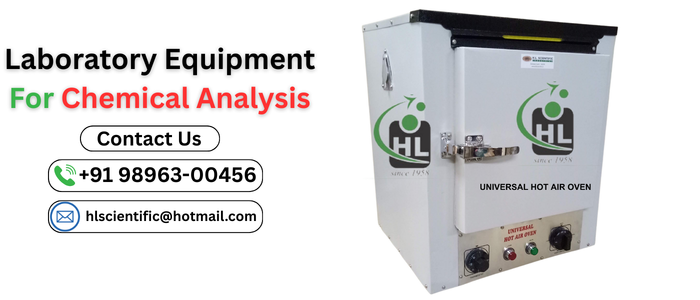
Hot Air Oven – Dry heat sterilization or heating.
-
Vacuum Oven – Heating under vacuum to remove moisture/volatiles.
-
Autoclave – Steam sterilization under pressure.
-
Water Bath – Maintains sample at stable temperature in water.
-
Rectangular (or Digital) Water Bath – Flat-bottomed, for tubes or flasks.
-
Stability Chamber – Controls temperature/humidity for storage testing.
-
Humidity Cabinet – Maintains a controlled humid environment.
-
Laminar Flow Cabinet – Provides a clean air workspace for sterile work.
-
Refrigerator (Lab) – For storing heat-sensitive reagents.
-
Mortuary Chamber (for biological labs) – Specialized cold chamber. (H.L. Scientific makes these)
4. Mixing, Shaking & Agitation (Approx. 6)
-
Rotary Shaker – For mixing liquids gently in flasks.
-
Vortex Mixer – Rapid mixing of small tubes.
-
Magnetic Stirrer – Stirring using a magnetic bar inside the liquid.
-
Overhead Stirrer – For stirring more viscous liquids.
-
Roller Mixer – Rolling tubes for gentle mixing.
-
Orbital Shaker – Provides orbital motion to shake flasks.
5. Sample Handling & Processing (Approx. 8)
-
Microcentrifuge – For small volume separation (DNA, proteins).
-
Benchtop (High-speed) Centrifuge – For larger and faster separation. (e.g., 6,000–20,000 rpm)
-
Tissue Flotation Bath – For handling tissue samples for histology.
-
Organ Bath – For physiological experiments on tissues.
-
Soxhlet Extraction Unit – For extraction of compounds using solvents.
-
Distillation Setup / Distillation Unit – For purifying liquids.
-
Rotary Evaporator – (Sometimes used) for gentle evaporation under low pressure.
-
Microtome (Rotary) – For cutting very thin slices of tissue.
6. Analytical & Research Instruments (Approx. 10)
-
UV–VIS Spectrophotometer – Measures absorbance of UV/visible light.
-
Double-beam Spectrophotometer – Allows more precise comparisons.
-
Flame Photometer – For measuring metal ion concentrations.
-
pH/Conductivity/TDS Meter – Combined instrument for multiple measurements.
-
Dissolved Oxygen Meter – As above (#26), sometimes counted here.
-
Karl Fischer Titrimeter – As above (#27).
-
Colony Counter – As above (#28).
-
Electrophoresis Unit – For DNA/RNA/protein separation. (H.L. Scientific offers electrophoresis units)
-
Tissue Processor – Automates tissue dehydration, clearing, infiltration.
-
Colorimeter / Auto Colorimeter – Measures concentration of substances by color. (H.L. Scientific: auto-colorimeter)
7. Physics / Engineering Apparatus (Approx. 14)
-
Optical Bench – For experiments in optics (lenses, mirrors).
-
Michelson Interferometer – For interference experiments.
-
Force Table – For vector addition of forces.
-
Inclined Plane – For studying motion on a slope.
-
Spectrometer (Optical) – For measuring light spectra.
-
Laser System (Teaching) – For laser optics experiments.
-
Electromagnetic Induction Kit – To demonstrate induction laws.
-
Resonance Apparatus – For studying oscillations and resonance.
-
Torsion Balance / Torsion Apparatus – For measuring small forces via torsion.
-
Magnetic Field Mapping Tools / Magnetometer – For mapping magnetic field lines.
-
GM Counter – Geiger-Müller counter for detecting radiation.
-
LCR Bridge / LCR Meter – For measuring inductance (L), capacitance (C), resistance (R).
-
Triode / Valve Characteristic Kit – For studying electronic tube behaviors.
-
Thermal Conductivity / Heat Transfer Apparatus – For experiments in thermodynamics (often part of physics kits).
8. Microscopy & Imaging (Approx. 6)
-
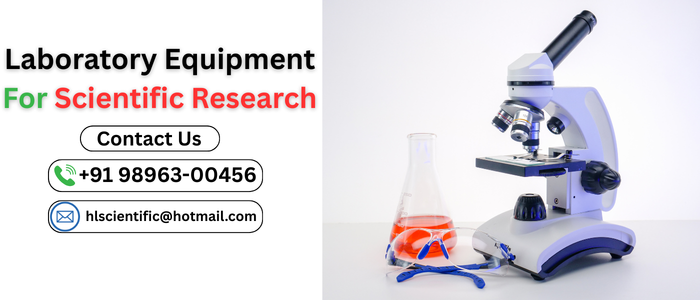
Compound Microscope – For observing small specimens (cells, bacteria). (H.L. Scientific makes various microscopes)
-
Trinocular Microscope – For viewing while also having a camera port.
-
Fluorescence Microscope – For observing fluorescently labeled samples.
-
Stereo Microscope – For 3D viewing of larger samples (e.g., insects).
-
Digital Microscope – With a camera and screen.
-
Phase Contrast Microscope – For viewing transparent cells without staining.
9. Biological & Forensic Tools (Approx. 8)
-
Anatomical Models – e.g., models of organs, skeletons. (H.L. Scientific supplies anatomical models)
-
Forensic Models – Crime-scene or pathology demonstration models.
-
Tissue Flotation Bath – (Also in sample handling) for histology.
-
Organ Bath – For physiological or pharmacological testing of tissue.
-
Microtome – (again) for slicing tissue samples.
-
Immersion Oil – For use with certain microscopy.
-
Gas Pack Jar (Anaerobic) – For bacteria growth in oxygen-free conditions.
-
Blood-bank Refrigerator – For storing blood or biological samples. (H.L. Scientific manufactures this
How H.L. Scientific Fits into This
-
H.L. Scientific’s catalog covers a large portion of the above items: from basic glassware (beakers, flasks, pipettes) to advanced analytical instruments (spectrophotometers, electrophoresis units).
-
They also manufacture physics education kits (optics, interferometers, induction, etc.).
-
For biological labs, they provide microscopes, microtomes, organ baths, and models.
-
In terms of safety and environment, they offer laminar flow cabinets and other controlled environment equipment.
-
Their strength is not just in standard items, but custom solutions — if a lab needs a special configuration or customized teaching module, H.L. Scientific can provide it.
Why Such a Broad List Is Useful
-
Education: For schools, colleges, and universities to design their lab curriculum, having a checklist of commonly needed instruments helps planning and budgeting.
-
Research: Research labs can use such a list to ensure they have the baseline equipment before upgrading to specialized instruments.
-
Purchasing & Vendor Selection: Knowing what vendors like H.L. Scientific offer helps labs decide whether to buy local, import, or go for custom-built setups.
-
Maintenance & Inventory: Keeping track of 90 core items helps in inventory management, maintenance scheduling, and safety compliance.
Conclusion
-
A 90-item lab equipment list gives a comprehensive but manageable snapshot of what many scientific labs need.
-
H.L. Scientific Industries is a well-established, certified manufacturer that covers a very wide portion of this list, making them a strong candidate for supplying lab equipment.
-
When planning or purchasing lab equipment, labs should consider both the essential tools (glassware, measuring devices) and more specialized instruments (spectrophotometers, interferometers), as well as customization needs.