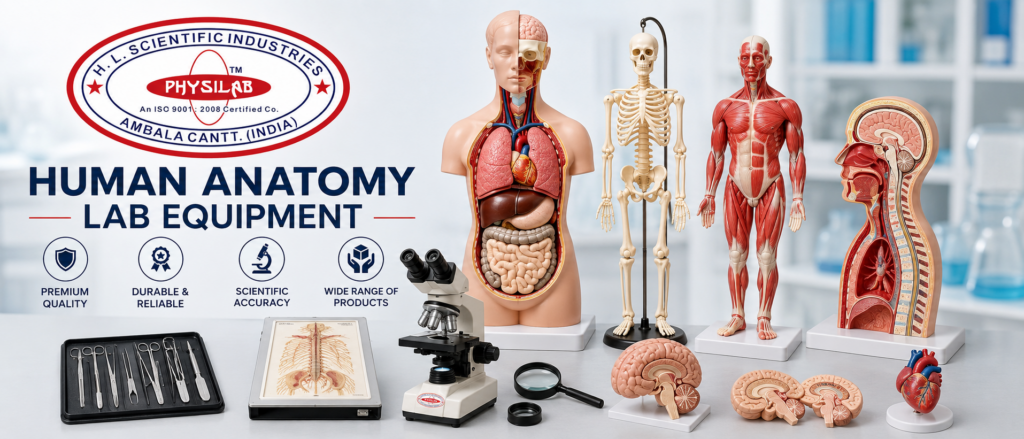
Human anatomy laboratories are essential for medical colleges, nursing institutes, biology laboratories, and research centers. These laboratories help students and researchers understand the structure and functions of the human body through practical learning, dissections, microscopic studies, and anatomical demonstrations. A well-equipped anatomy lab improves scientific knowledge, observation skills, and clinical understanding.
H.L. Scientific Industries
H.L. Scientific Industries is a leading manufacturer and supplier of laboratory equipment, anatomical models, scientific instruments, educational lab apparatus, microscopes, histology instruments, and medical laboratory products in India. The company provides quality laboratory solutions for schools, colleges, universities, hospitals, research laboratories, and medical institutes.
Contact Information
Company Name: H.L. Scientific Industries
Address: #54, New Colony, Opposite Industrial Area, Ambala Cantt – 133001, Haryana, India
Phone: +91 9896300456
Email: hlscientific@hotmail.com
50 Human Anatomy Lab Equipment List
1. Human Skeleton Model
Used for studying the skeletal system, bones, joints, and body structure.
2. Human Torso Model
Demonstrates internal organs such as lungs, liver, stomach, and intestines.
3. Skull Model
Helps students study cranial bones, jaw structure, and facial anatomy.
4. Brain Model
Used for understanding different parts of the brain and nervous system.
5. Heart Model
Shows chambers, valves, arteries, and blood circulation pathways.
6. Eye Model
Used to study eye anatomy, retina, lens, and optic nerve structure.
7. Ear Model
Demonstrates external, middle, and inner ear anatomy.
8. Kidney Model
Used for studying kidney structure and urinary functions.
9. Lung Model
Shows respiratory organs and lung functioning.
10. Liver Model
Helps explain liver anatomy and digestive functions.
11. Digestive System Model
Demonstrates the human digestive tract and related organs.
12. Muscular System Model
Used to study human muscles and muscular movements.
13. Nervous System Model
Explains nerves, spinal cord, and neural pathways.
14. Reproductive System Model
Used for studying male and female reproductive anatomy.
15. DNA Model
Demonstrates DNA structure and genetic arrangement.
16. Binocular Microscope
Used to observe tissues, cells, and microorganisms.
17. Compound Microscope
Provides magnified views of biological specimens.
18. Digital Microscope
Displays enlarged images on a screen for easy observation.
19. Histology Slides
Prepared slides used for tissue examination.
20. Slide Storage Box
Protects and organizes microscope slides.
21. Scalpel
Used for precise cutting during dissections.
22. Dissection Scissors
Used to cut tissues and biological specimens.
23. Forceps
Helps hold tissues and small body parts during experiments.
24. Dissecting Tray
Provides a safe platform for dissections.
25. Needle Holder
Used to hold surgical needles securely.
26. Probe
Used for examining organs and body cavities.
27. Bone Cutter
Cuts bones during anatomical studies.
28. Bone Saw
Used for cutting hard skeletal structures.
29. Autopsy Table
Supports cadaver examination and dissection work.
30. Preserved Specimen Jar
Used for storing biological samples safely.
31. Cadaver Storage Tank
Maintains preserved human cadavers for teaching.
32. Refrigerator
Stores biological samples and chemicals at low temperature.
33. Mortuary Chamber
Used for preserving cadavers in anatomy labs.
34. Laboratory Thermometer
Measures temperature during experiments.
35. Digital Weighing Balance
Measures specimen and chemical weight accurately.
36. pH Meter
Measures acidity or alkalinity of solutions.
37. Water Bath
Maintains constant temperature for samples.
38. Hot Plate
Used for heating laboratory solutions.
39. Centrifuge Machine
Separates components of blood and other fluids.
40. Laminar Air Flow Cabinet
Provides sterile working conditions in laboratories.
41. Stethoscope
Used for listening to heartbeats and lung sounds.
42. Sphygmomanometer
Measures blood pressure.
43. Spirometer
Measures lung capacity and respiratory function.
44. Pulse Oximeter
Measures oxygen saturation in blood.
45. Hemocytometer
Counts blood cells under microscopic observation.
46. Haemometer
Used for hemoglobin estimation.
47. Organ Bath Apparatus
Used in physiology and pharmacology studies.
48. Tissue Flotation Bath
Helps prepare tissue sections for microscopic analysis.
49. Microtome
Cuts thin tissue slices for histology studies.
50. Anatomical Charts
Used for visual teaching of body systems and organs.
Importance of Human Anatomy Laboratory Equipment
Human anatomy lab equipment is essential for:
- Medical education and training
- Nursing and paramedical studies
- Biological research
- Histology and pathology studies
- Clinical demonstrations
- Understanding human body systems practically
Modern anatomy laboratories combine anatomical models, microscopes, dissection tools, and digital instruments to improve practical learning and research efficiency.