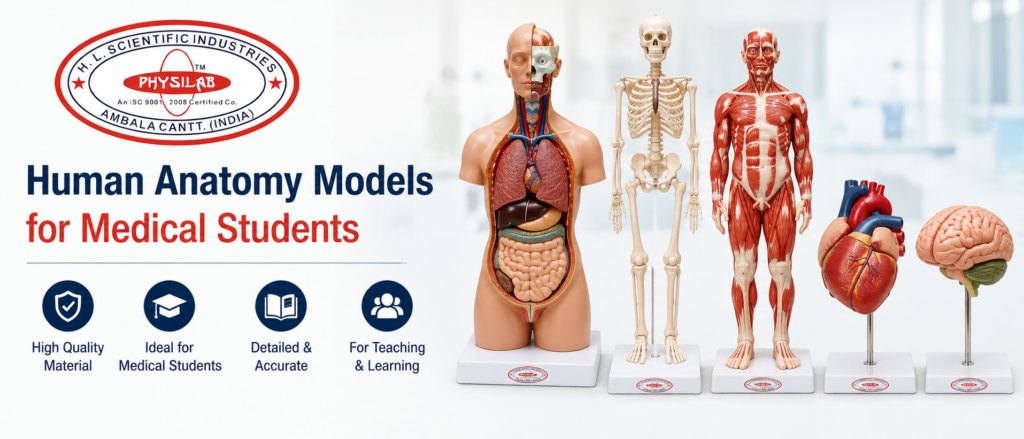
Human anatomy models are essential teaching tools used in medical colleges, nursing institutes, biology laboratories, and healthcare training centers. These scientifically designed models help students understand the structure and function of the human body through practical and visual learning. From skeleton systems to internal organs, anatomy models provide an interactive learning experience that improves medical education and clinical understanding. According to educational and medical training resources, anatomical models are widely used to simplify complex body structures and improve anatomical understanding among students and healthcare professionals.
H.L. Scientific Industries – Trusted Supplier of Anatomy Models
H.L. Scientific Industries is a trusted manufacturer and supplier of laboratory and educational equipment in India. The company provides high-quality human anatomy models designed for medical students, nursing education, biology laboratories, and healthcare institutions.
Contact Information
Company Name: H.L. Scientific Industries
Address: #54, New Colony, Opposite Industrial Area, Ambala Cantt – 133001, Haryana, India
Phone: +91 98963-00456
Email: hlscientific@hotmail.com
Product Range Includes:
- Human Skeleton Models
- Human Torso Models
- Brain Anatomy Models
- Heart Models
- Eye and Ear Models
- Dental Models
- Muscular System Models
- Anatomical Charts and Laboratory Equipment
Importance of Human Anatomy Models
Human anatomy models play a major role in medical education because they allow students to study body systems in detail without depending entirely on cadaver dissection. These models improve visualization, memory retention, and practical learning skills. Modern anatomy education increasingly uses 3D and interactive models to enhance understanding of organs, tissues, muscles, and skeletal systems.
Medical students use anatomy models for:
- Understanding body structure and organ placement
- Learning skeletal and muscular systems
- Studying internal organs and physiological functions
- Demonstrating medical concepts in classrooms
- Practicing clinical and nursing education
- Laboratory and research training
Types of Human Anatomy Models
Human Skeleton Models
Skeleton models display the complete bone structure of the human body. These models are commonly used in medical colleges, nursing institutes, physiotherapy training centers, and biology laboratories.
Features include:
- Life-size human skeleton structure
- Flexible joints and detachable parts
- Bone marking and muscle attachment details
- Durable PVC construction
Human Torso Models
Human torso models show internal organs such as the heart, lungs, liver, stomach, intestines, and kidneys. Many torso models include removable organs for better understanding and practical demonstration. Educational suppliers describe torso models as highly effective teaching aids for anatomy and physiology studies.
Brain Anatomy Models
Brain models help students learn about the cerebrum, cerebellum, nerves, and brain functions. These models are widely used in neurology and psychology education.
Heart Anatomy Models
Heart models explain chambers, valves, blood circulation, and cardiovascular functions. These are useful for medical and nursing students.
Eye, Ear, and Dental Models
Specialized anatomical models are designed for ENT, dental, and ophthalmology education. They help students understand organ structures in detail.
Advantages of Using Anatomy Models
- Easy visualization of complex structures
- Interactive and practical learning
- Long-lasting and reusable educational tools
- Helpful for classroom demonstrations
- Improves student engagement and understanding
- Suitable for schools, colleges, laboratories, and hospitals
Medical educators and students frequently highlight the importance of detachable and 3D anatomical models for understanding spatial relationships within the body.
Applications of Human Anatomy Models
Human anatomy models are widely used in:
- Medical colleges
- Nursing institutes
- Biology laboratories
- Physiotherapy centers
- Healthcare training institutes
- Research laboratories
- Schools and universities
Human anatomy models are valuable educational tools that make medical learning more effective, interactive, and practical. They help students understand body systems clearly and support better clinical education. With advancements in 3D and anatomical teaching technology, these models continue to play a significant role in modern medical training.