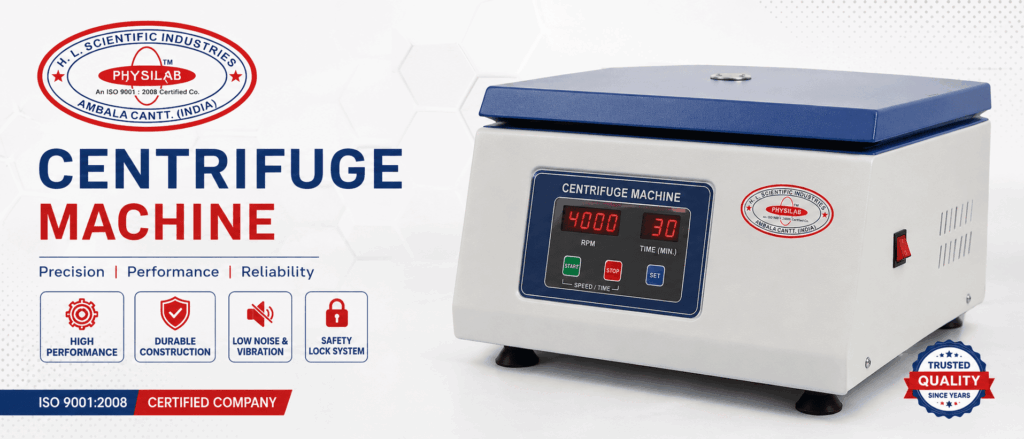
A centrifuge machine is one of the most important laboratory instruments used in hospitals, diagnostic centers, research laboratories, pharmaceutical companies, educational institutions, and industrial laboratories. It works by spinning samples at high speed to separate substances of different densities, making it essential for blood testing, urine analysis, chemical research, microbiology, biotechnology, and quality control.
What Is the Cost of a Centrifuge Machine?
If you are planning to purchase a centrifuge machine, one of the first questions you will have is: “What is the cost of a centrifuge machine?” The answer depends on several factors, including the machine’s speed (RPM), tube capacity, rotor type, digital controls, refrigeration, and intended application. In India, prices range from a few thousand rupees for basic clinical models to several lakh rupees for advanced refrigerated laboratory centrifuges.
H.L. Scientific Industries is an Indian manufacturer specializing in scientific laboratory equipment, educational laboratory instruments, pharmacy equipment, biological models, laboratory glassware, and laboratory centrifuge machines. With decades of manufacturing experience, the company serves schools, colleges, universities, hospitals, diagnostic laboratories, pharmaceutical companies, research institutes, and industrial laboratories in India and overseas.
Contact H.L. Scientific Industries
H.L. Scientific Industries
Regd. Office Address:
#54, New Colony, Opposite Industrial Area
Ambala Cantt – 133001, Haryana, India
Contact Number: +91 9896300456
Email: hlscientific@hotmail.com
Factors That Affect the Cost
1. Speed (RPM)
Higher RPM enables faster and more efficient sample separation. Machines with higher speed generally cost more.
2. Rotor Type
Different rotor configurations, such as fixed-angle and swing-out rotors, influence the price and applications.
3. Tube Capacity
Machines that accommodate more tubes or larger sample volumes are typically more expensive.
4. Digital Features
LCD displays, programmable settings, timers, memory functions, and automatic balancing add convenience and increase cost.
5. Refrigeration
Refrigerated centrifuges maintain low temperatures for sensitive biological samples and are significantly more expensive than standard models.
6. Build Quality
High-quality stainless steel chambers, durable motors, and low-vibration designs improve performance and longevity.
Common Applications
- Blood sample separation
- Serum and plasma preparation
- Urine analysis
- Clinical pathology laboratories
- Pharmaceutical quality control
- Biotechnology research
- Molecular biology
- Educational laboratories
- Food and beverage testing
- Environmental analysis
Tips for Choosing the Right Centrifuge
- Select the required RPM for your applications.
- Consider the number and size of sample tubes processed daily.
- Choose a digital model for improved accuracy.
- Purchase from an experienced manufacturer offering service support.
- Check warranty, spare part availability, and after-sales assistance.
- Ensure compliance with laboratory safety standards.