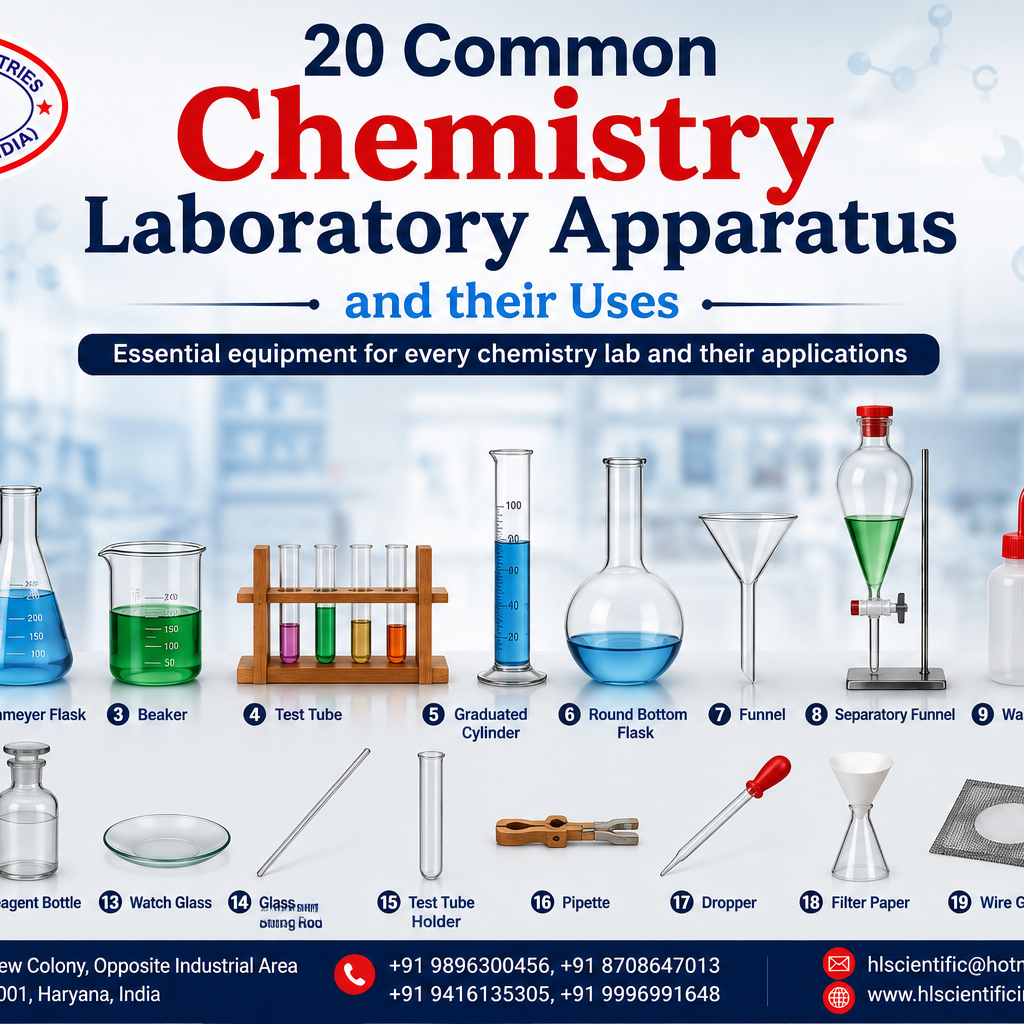
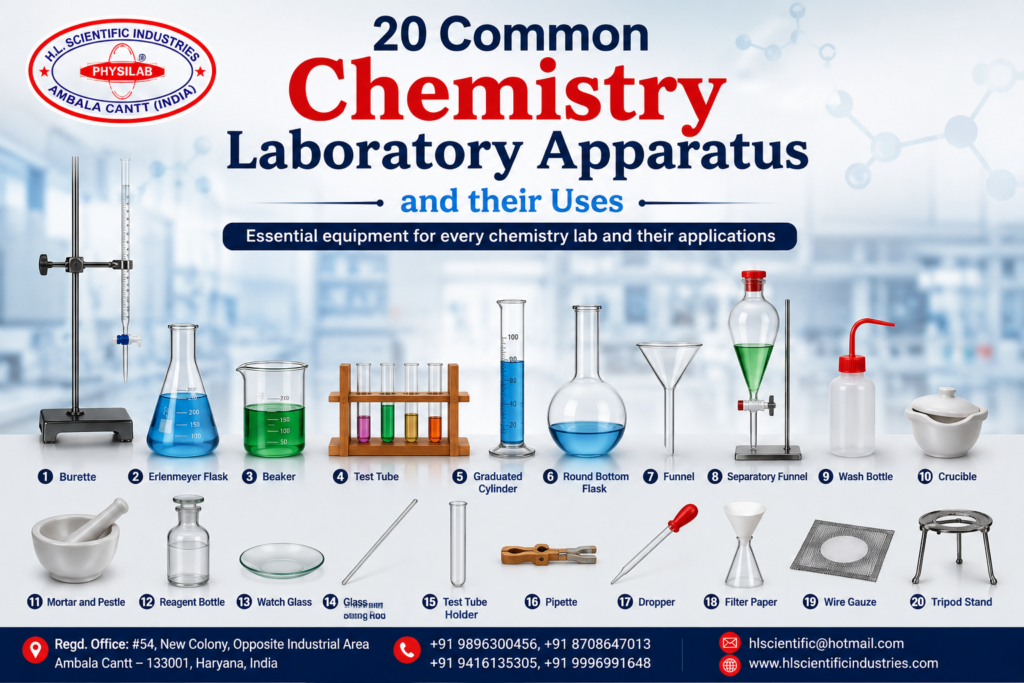
20 Common Chemistry Laboratory Apparatus and Their Uses
H.L. Scientific Industries provides laboratory and educational science equipment for schools, colleges, universities, research institutions and other scientific organizations.The company offers a range of laboratory products, including chemistry laboratory apparatus, glassware, educational laboratory equipment and scientific instruments. Choosing suitable laboratory equipment can help institutions create practical laboratories that support effective science education and experimentation.
Contact H.L. Scientific Industries
Registered Office Address:
#54, New Colony, Opp. Industrial Area
Ambala Cantt – 133001, Haryana, India
Contact Numbers:
+91-9896300456
+91-8708647013
+91-9416135305
+91-9996991648
Email: hlscientific@hotmail.com
1. Beaker
A beaker is one of the most familiar pieces of chemistry laboratory glassware. It is generally cylindrical, has a flat bottom and a small pouring lip.
Beakers are commonly used for holding, mixing, stirring and heating liquids.
Common uses:
- Mixing chemical solutions
- Holding samples
- Preparing solutions
- Transferring liquids
2. Test Tube
Test tubes are small cylindrical tubes commonly made from glass or laboratory-grade plastic. They are useful when only a small quantity of a chemical is required for an experiment.
Students frequently use test tubes for observing chemical reactions.
Common uses:
- Holding small quantities of chemicals
- Performing small-scale reactions
- Heating samples
- Observing colour or reaction changes
3. Conical Flask
A conical flask, also called an a narrow neck. Its shape makes it convenient for swirling liquids with less risk of splashing.
Conical flasks are particularly useful during chemical reactions and titration experiment.
Common uses:
- Mixing solutions
- solution preparation
- Heating liquids
- Holding reaction mixtures
- Temporary storage of solutions
4. Measuring Cylinder
A measuring cylinder is designed to measure the volume of liquids more accurately than an ordinary beaker.
It has graduation marks along its body and is available in different sizes. It is useful when a s measured quantity of liquid is needed but the very high precision of volumetric glassware is not required.
Common uses:
- Measured Quantity Of Liquid
- Preparing mixtures
- Transferring measured quantities of liquids
- Routine laboratory experiments
5. Burette
It is one of the most important pieces of apparatus used in titration
During a titration, the burette allows the experimenter to add a solution gradually while recording the volume delivered.
Common uses:
- Acid-base titration
- Redox titration
- Measuring accurately delivered liquid volumes
- Analytical chemistry experiments
6. Pipette
A pipette is used to transfer a measured quantity of liquid from one container to another. Different types of pipettes are available, including volumetric and graduated pipettes.
A volumetric pipette is designed to d
eliver a specific volume with high accuracy, making it useful in quantitative chemical analysis.
Common uses:
- Transferring measured liquids
- Preparing standard solutions
- Titration experiments
- Analytical laboratory work
7. Volumetric Flask
A volumetric flask has a round body, a long narrow neck and a calibration mark. It is specifically designed for preparing solutions to a precise volume.
For example, when preparing a standard solution, the required substance can be dissolved and the solution made up to the calibration mark.
Common uses:
- Preparing standard solutions
- Diluting solutions accurately
- Quantitative analysis
- Preparing solutions of known concentration
8. Funnel
A laboratory funnel makes it easier to transfer liquids from one container to another without unnecessary spilling.
Funnels are available in different materials and designs depending on the laboratory application.
Common uses:
- Transferring liquids
- Filtration
- Filling narrow-neck containers
- Separating solids from liquids when used with filter paper
9. Watch Glass
A watch glass is a shallow, circular piece of laboratory glassware. Despite its simple appearance, it has several useful applications.
It can be used for holding small quantities of substances, covering a beaker, or allowing small quantities of liquid to evaporate.
Common uses:
- Holding small samples
- Evaporating small amounts of liquid
- Covering beakers
- Supporting samples during observation
10. Glass Stirring Rod
A glass stirring rod is a simple but essential laboratory tool used to mix solutions manually.
Glass rods are generally chemically resistant and can be used with many common laboratory solutions. They can also assist in controlled pouring when used with suitable glassware.
Common uses:
- Stirring solutions
- Mixing chemicals
- Helping dissolve substances
- Guiding liquids during pouring
11. Bunsen Burner
A Bunsen burner is a common laboratory heating device that produces an adjustable flame. It is traditionally used in chemistry laboratories for heating substances and carrying out experiments that require a flame.
Because it involves an open flame, it should always be used with appropriate laboratory safety procedures.
Common uses:
- Heating chemicals
- Heating glassware
- Carrying out flame tests
- Supporting experiments requiring controlled heating
12. Tripod Stand
A tripod stand is a three-legged support used during heating experiments. Glassware such as beakers or evaporating dishes can be placed on a wire gauze supported by the tripod.
It provides a stable platform above a laboratory burner.
Common uses:
- Supporting beakers during heating
- Supporting evaporating dishes
- Holding wire gauze
- Providing stability during heating experiments
13. Wire Gauze
Wire gauze is generally placed between a tripod stand and the glassware being heated. It helps support the container and spreads heat over a wider area.
This can help reduce the direct impact of a flame on one small area of the glassware.
Common uses:
- Supporting beakers and flasks
- Distributing heat
- Providing a stable heating surface
14. Crucible
A crucible is a small heat-resistant container designed for heating substances to high temperatures. Crucibles are commonly made from materials.
They are particularly useful when a solid substance needs strong heating.
Common uses:
- Heating solid chemicals
- Ignition experiments
- Heating samples to high temperatures
- Certain gravimetric analysis procedures
15. Mortar and Pestle
A mortar and pestle are used grind and mix solid substances. The mortar is the bowl-shaped container.
They are useful when a solid chemical needs to be converted into a finer powder before an experiment.
Common uses:
- Grinding solid chemicals
- Crushing crystals
- Mixing powders
- Preparing samples for experiments
16. Test Tube Rack
A test tube rack provides a stable place to keep test tubes upright. It is useful when several samples are being handled at the same time.
A rack helps organize test tubes and reduces the possibility of accidentally knocking them over.
Common uses:
- Holding test tubes
- Organizing samples
- Supporting test tubes during experiments
- Allowing test tubes to dry after washing
17. Retort Stand
A retort stand consists of a heavy base and a vertical metal rod. Clamps can be attached to the rod to support laboratory glassware and other equipment.
It is commonly used when an experiment requires apparatus to be held at a particular height or position.
Common uses:
- Supporting burettes
- Holding flasks
- Supporting condensers
- Setting up filtration or distillation equipment
- Securing laboratory apparatus
18. Thermometer
A thermometer is used to measure the temperature of substances or experimental systems. Temperature measurement is important in many chemical reactions because reaction behaviour can change with temperature.
Modern laboratories may use digital thermometers as well as traditional laboratory thermometers.
Common uses:
- Measuring liquid temperature
- Monitoring heating experiments
- Recording temperature changes
- Controlling experimental conditions
19. Dropper
A laboratory dropper is designed to transfer liquids in small quantities, usually one drop at a time. It is useful when a chemical such as an indicator or reagent needs to be added gradually.
Droppers are especially common in school and college practical laboratories.
Common uses:
- Adding indicators
- Transferring small amounts of reagents
- Adding chemicals drop by drop
- Carrying out qualitative tests
20. Distillation Apparatus
Distillation apparatus consists of several pieces of laboratory equipment, which may include a distillation flask, thermometer.
The setup is used to separate or purify components of a liquid mixture based on differences in their boiling behaviour.
Common uses:
- Purifying liquids
- Separating liquid mixtures
- Recovering solvents
- Demonstrating boiling and condensation
- Chemistry teaching and research experiments